
Putnam County Court Records After a Jail Arrest
The main point for Putnam County is that a jail arrest charge is not automatically the same thing as a formal court charge. A person may be arrested, booked at Putnam County Jail, and shown in jail paperwork under the officer's or warrant's charge language. After that, the prosecutor reviews the case. The filed case record can use different wording, add a count, reduce a count, dismiss a count, bind a matter over, or move the case into a different court track.
Putnam County Clerk of Courts is the access point for Superior, State, and Juvenile Court records. The clerk site identifies Trevor J. Addison as Clerk of Superior Court, State Court, and Juvenile Court, as well as jury manager and tax appeal administrator. The clerk's office lists case search, certified copies, forms, calendars, ticket services, and e-filing links. For custody status, use jail inmate records. For booking photographs, use jail roster mugshots. For filed court charges after an arrest, use the clerk and court channels.
The Putnam County Clerk of Courts website is the official starting point for case search and certified-copy services.
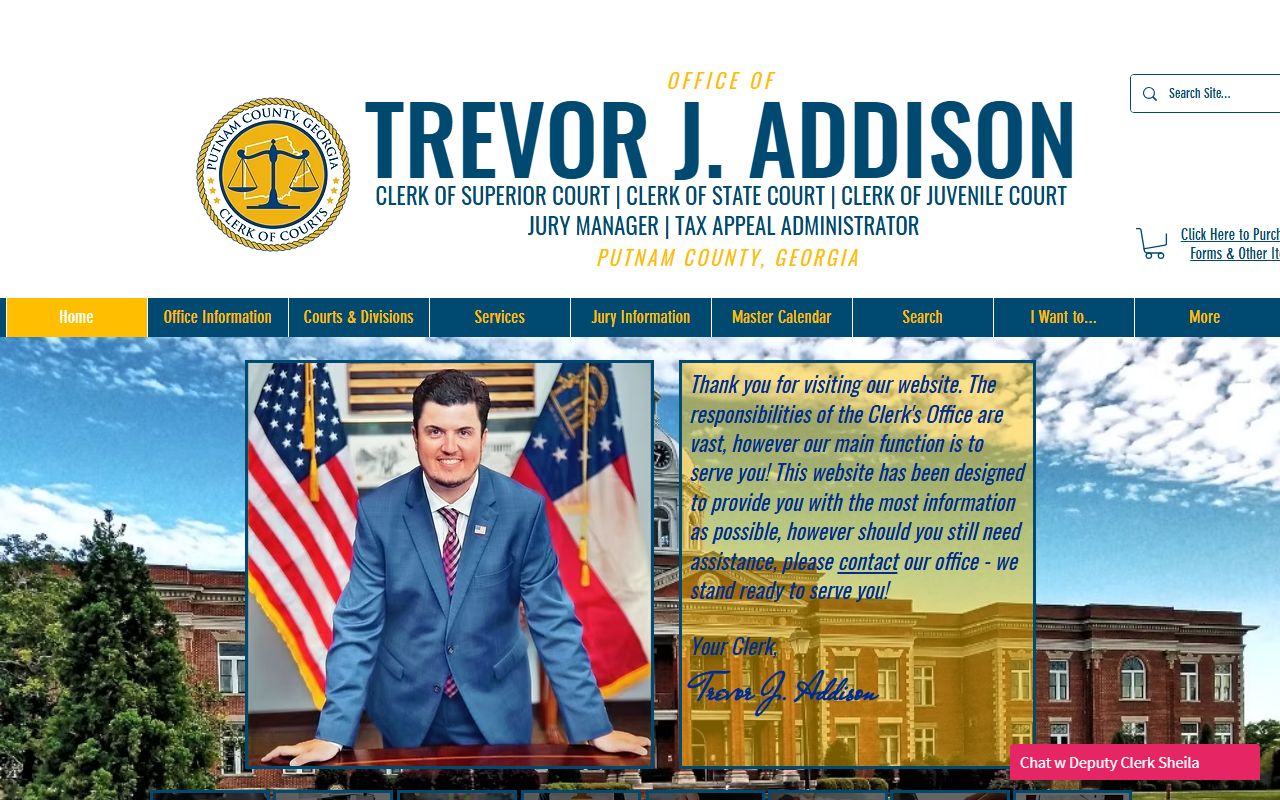
The clerk page matters because the jail cannot certify a court disposition or substitute for the court docket after charges are filed.
How to Find Putnam County Court Records After an Arrest
The clerk site links case search to putnamclerkofcourt.com. During research, direct inspection of that portal looped to a default page with VIEWONLY cookies, so no search-field labels were confirmed. If the portal loads in a browser, use the fields displayed there. If the portal loops, fails, or does not show the needed case, contact the clerk's office directly.
- Start with the person's full legal name, date of birth or approximate age, arrest date, arresting agency, and any case, citation, warrant, or booking number.
- Open the clerk-linked case search and search using the fields the portal provides.
- Review the case caption, court, filing date, charge list, events, hearing calendar, bond entries, and disposition fields if visible.
- If the portal does not return a clear case, contact the clerk at (706) 485-4501 or info@putnamcourtclerk.org.
- For certified copies, use the clerk's certified-copy service or counter process. A sheriff booking record is not a certified court disposition.
The clerk's office is listed at 100 South Jefferson Avenue, Suite 236, Eatonton, GA 31024. That courthouse address is separate from the Putnam County Jail at 111 Ridley Drive and separate from Eatonton Police headquarters and Municipal Court at 214 West Marion Street.
Arrest to Court Records Timeline
A typical Putnam County state-law path begins with arrest, then booking into the county jail if the person is held locally. Bond and first appearance may follow quickly, often before the final filed charge is clear to a public searcher. The prosecutor then decides how to proceed. Felony and serious state-law prosecutions route through the Ocmulgee Judicial Circuit District Attorney. Some misdemeanors, traffic cases, ordinance matters, warrant proceedings, or juvenile matters may belong in other court channels.
| Stage | Record to Check | Why It Matters |
|---|---|---|
| Arrest | Agency or warrant record | Identifies why the person was taken into custody. |
| Jail booking | Sheriff jail record | Shows custody, initial charge language, commitment date, and bond routing. |
| First appearance or bond | Magistrate or court order | May set conditions and future court dates. |
| Prosecutor review | DA or solicitor/court filing | Formal charges may be filed, declined, amended, or reduced. |
| Docket creation | Clerk case record | Tracks court events, filings, hearings, and dispositions. |
| Disposition | Certified court record | Shows plea, dismissal, nolle prosequi, conviction, sentence, or probation outcome. |
Charging Documents After a Putnam County Arrest
The charging document is where the court record moves beyond the jail's arrest charge. Georgia criminal cases can involve complaints, accusations, informations, indictments, citations, warrants, or other filed documents depending on charge level and court. The research file does not provide a Putnam-specific sample charging document, so the table below explains the functional differences without inventing local form fields.
| Document | Usually Comes From | Common Use | What to Compare |
|---|---|---|---|
| Warrant or complaint | Law enforcement, court, or prosecutor | Initial arrest or early case basis | Compare with jail booking charge and first appearance entries. |
| Accusation or information | Prosecutor | Formal non-indictment charging in eligible cases | Check charge wording, count numbers, and filing date. |
| Indictment | Grand jury | Many felony or serious criminal cases | Check whether the indicted count differs from the arrest charge. |
| Citation or ticket | Officer or municipal/state process | Traffic, ordinance, or lower-level matters | Check whether payment, appearance, or transfer applies. |
Charge Status in Court Records After an Arrest
Charge status can change several times after booking. A charge may remain pending, be bound over, be formally accused or indicted, be amended, be reduced through plea negotiation, be dismissed, be dead-docketed, or be marked nolle prosequi. A jail record may keep the original arrest wording even after the court case changes.
| Status | What It Means | Where to Verify |
|---|---|---|
| Pending | The charge or case remains unresolved. | Clerk docket and court calendar. |
| Bound over | A lower court sends the matter to a higher court for further action. | Magistrate and Superior Court records. |
| Accused or indicted | A formal charging document has been filed. | Clerk case file. |
| Amended or reduced | The filed charge changed from an earlier version. | Case filings, plea paperwork, and disposition. |
| Dismissed | The court dismissed the count or case. | Certified disposition from the clerk. |
| Nolle prosequi | The prosecutor chose not to pursue the charge. | Clerk docket and filed order or entry. |
| Conviction or guilty plea | The case ended in guilt by verdict or plea. | Sentence and disposition record. |
Bond and Release Records After an Arrest
Bond may appear in jail, warrant, and court records, but those entries do not always mean the same thing. The sheriff's jail page says most prisoners can be released on bond after arrest and identifies cash, property, and commercial bonds. A cash bond is paid in U.S. currency. A property bond requires sufficient equity approved by the sheriff and includes a $20 state-law preparation fee. A commercial bond must come from a bondsman approved to do business in Putnam County by the sheriff.
| Bond Item | Access Point | Caution |
|---|---|---|
| Current bond amount | Jail phone or court order | Verify immediately before payment because court orders can change. |
| Cash bond | Jail or court payment instructions | Ask whether the full amount and payment form are accepted. |
| Property bond | Sheriff approval process | Equity, owner documents, and the $20 fee must be confirmed. |
| Commercial bond | Sheriff-approved bondsman | Private fees are nonrefundable and the approved list can change. |
| No-bond hold or detainer | Jail, court, or holding agency | A person may remain jailed because of probation, parole, another county, ICE, or federal custody. |
Warrants That Lead to Court Records After an Arrest
Putnam County Sheriff's Office publishes a Warrants & Civil Process page, but no general searchable active-warrant database was found. The page says all warrants issued by courts in Putnam County are directed to the sheriff for execution, and the sheriff also serves warrants from other counties and states when wanted persons are located in Putnam County. The page lists approximately 500 active arrest warrants on average and names Mrs. Amy Hood as the warrant/civil process contact.
For warrant questions, use warrants@putnamcountysheriff.org, ahood@putnamcountysheriff.org, or (706) 485-8557 ext. 206. Bench warrants, failure-to-appear warrants, municipal matters, and juvenile matters may require contacting the issuing court. The sheriff's Most Wanted page is a wanted-person publication, not a complete warrant database and not a jail roster.
The official Warrants & Civil Process page is the source for Putnam's warrant contact route and civil-process fee table.
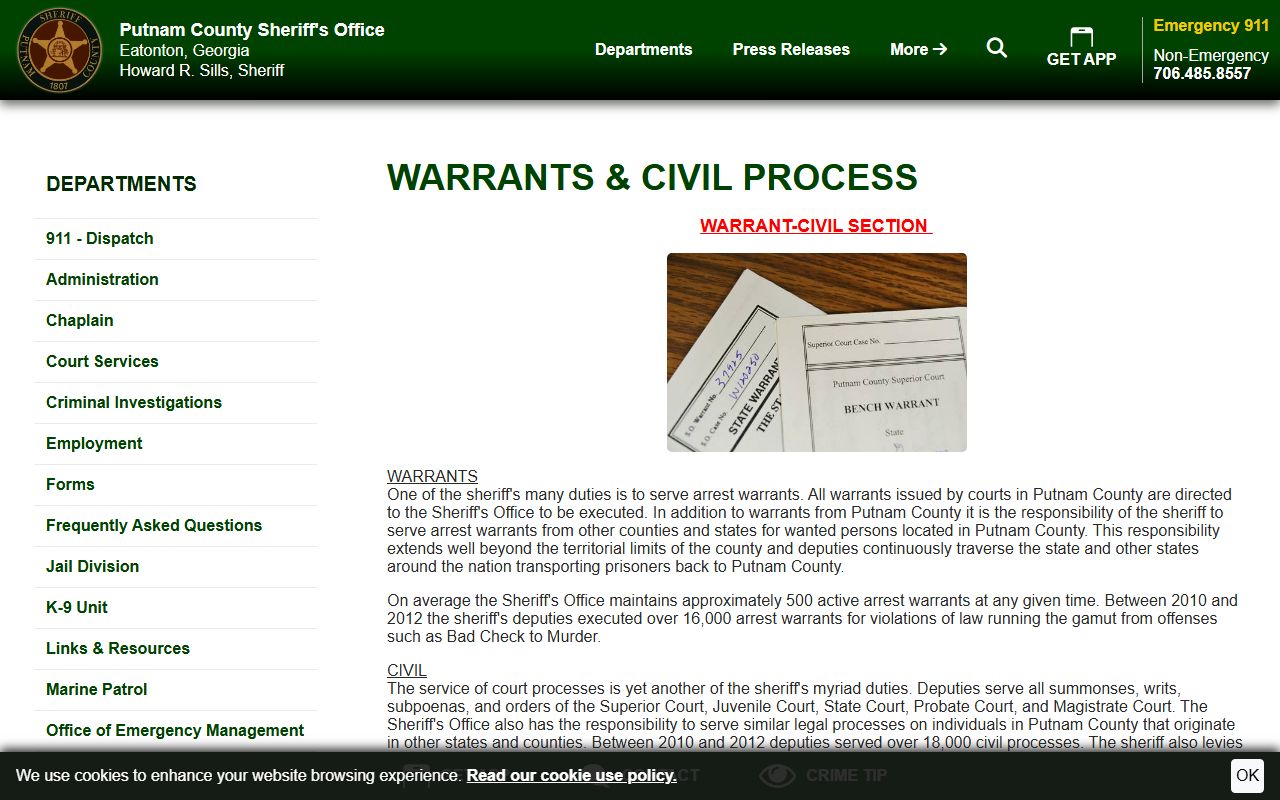
The warrant page helps explain why an arrest record may begin with a court-issued warrant and later become a clerk-tracked criminal case.
Charges vs. Convictions in Putnam County Court Records
An arrest charge is an accusation, not a conviction. A court charge is also an accusation until the case reaches a guilty plea, verdict, dismissal, nolle prosequi, or other final disposition. This distinction matters when reading Putnam County court records after an arrest because public entries can show serious allegations that were later reduced, dismissed, or resolved differently.
| Charge | Conviction | |
|---|---|---|
| Stage | Allegation after arrest, warrant, accusation, information, or indictment | Final guilt finding by plea or verdict |
| Record source | Jail record, warrant, prosecutor filing, or court docket | Disposition, sentence, or certified court record |
| Can change? | Yes, it can be amended, reduced, added, or dismissed | Can be appealed, corrected, or affected by later court order |
| Use for background decisions? | Verify and do not treat as guilt | Use only through lawful, compliant channels when required |
Sealed, Restricted, and Expunged Arrest Records
Georgia generally uses the language of record restriction rather than the casual phrase "expungement" for many criminal-history access limits. O.C.G.A. § 35-3-37 is the research-cited framework for eligible arrests or dispositions. A dismissal, nolle prosequi, acquittal, or eligible outcome does not automatically remove every reference from every sheriff, clerk, prosecutor, jail, GBI/GCIC, or third-party system.
| Sealed or Restricted | Expunged | |
|---|---|---|
| Plain meaning | Public access is limited under law or court order | Often used casually to mean erased, but Georgia processes should be checked by statute and order |
| Public visibility | May be hidden from ordinary public searches | May still require separate action across systems if available under law |
| Law enforcement access | May remain available to authorized agencies | Depends on the governing order and law |
| Where to start | Clerk, court order, attorney, GBI/GCIC process | Do not assume the jail can remove court or criminal-history records by itself |
Restricted Court Records After an Arrest in Putnam County
Some records may be confidential, restricted, sealed, redacted, or unavailable online. Juvenile Court matters are especially sensitive. Active investigations, sealed filings, certain victim information, medical or personal identifiers, and records covered by specific exemptions may not appear in a public portal. The Georgia Open Records Act creates a process to request records, but it also recognizes exemptions and redactions. If a record does not appear online, contact the clerk or originating agency before concluding that no case exists.
Important: This site is not a consumer reporting agency under the FCRA. Do not use casual lookup information for employment, tenant screening, credit, insurance, or other regulated decisions.
District Attorney and Court Routing
Putnam County is part of the Ocmulgee Judicial Circuit. The District Attorney's website identifies T. Wright Barksdale III as District Attorney and says the circuit serves Baldwin, Greene, Hancock, Jasper, Jones, Morgan, Putnam, and Wilkinson Counties. The main office listed is the Jones County Government Center, 166 Industrial Blvd., Gray, GA 31032, phone (478) 986-3166.
Superior Court generally handles felony-level cases and serious criminal matters. State Court handles many misdemeanor and traffic matters. Magistrate Court can be involved in warrants, first appearances, preliminary issues, and some lower-level matters. Eatonton Municipal Court is housed with the Eatonton Police Department for city matters. Juvenile Court handles youth matters and may have restricted access. When the question is "what charge did the prosecutor file after the jail arrest," the clerk and court record should control over an initial booking label.